Candidate: William Herrington
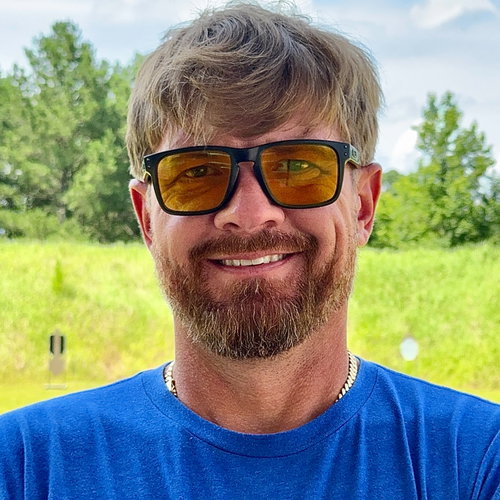
William Herrington
Purvis, MS
As long as I can remember I have always been around guns and been shooting. Even as a career infantryman I have always had a love for handguns. The rifle was the tool of my trade, but the handgun always kept a special place in my heart and still does to this day.
In May 2021, I took Brayden who was 14, and we attended our first USPSA match. To say that we were hooked would be an understatement. We both started in carry optics.
Now I find myself in Open and having a blast. I enjoy the process, building and directing my local match, getting law enforcement guys to try out USPSA and watching them get hooked. I love finding the new shooters at the range when setting up and convincing them to come out the next morning and covering their match fee for their first match. Most importantly I love the relationship Brayden and I have developed. A father and son at a tumultuous time in life were able to bond and he was able to see a side of his dad most don’t get to. He could understand we’re all human and we struggle, but we also persevere and win.
This is what drives me in my pursuit of Area 6 director. I know there are more stories like mine out there. Parents like me that have benefited from this sport. Folks who have found friendships and relationships that have and will stand the test of time. Ensuring what we know and love remains for the future while serving every member of Area 6 is what is needed and what I will bring.
In May 2021, I took Brayden who was 14, and we attended our first USPSA match. To say that we were hooked would be an understatement. We both started in carry optics.
Now I find myself in Open and having a blast. I enjoy the process, building and directing my local match, getting law enforcement guys to try out USPSA and watching them get hooked. I love finding the new shooters at the range when setting up and convincing them to come out the next morning and covering their match fee for their first match. Most importantly I love the relationship Brayden and I have developed. A father and son at a tumultuous time in life were able to bond and he was able to see a side of his dad most don’t get to. He could understand we’re all human and we struggle, but we also persevere and win.
This is what drives me in my pursuit of Area 6 director. I know there are more stories like mine out there. Parents like me that have benefited from this sport. Folks who have found friendships and relationships that have and will stand the test of time. Ensuring what we know and love remains for the future while serving every member of Area 6 is what is needed and what I will bring.
1. What motivates you to serve as a USPSA Area Director?
First and foremost, to represent Area 6 and the membership at the organizational level. To be a sounding board for their concerns and give them a powerful and unrelenting voice on the board and within the committees. There is always room for improvement; and by actively listening and cultivating an environment of communication and sense of community throughout Area 6, we can achieve our desire to lead positive change not only in our area but across the organization. Accountability and transparency require constant attention and watchful eyes addressing questionable decisions. It is incumbent upon the board members to embrace this and keep the health of the organization in mind as that directly affects each member within their area. I feel a sense of duty and responsibility to give back to the sport that has enriched my life. The unforgettable experiences, friendships, skills, and personal growth will never go fully repaid.
2. What actions have you taken to support and grow USPSA in your area prior to your candidacy?
As soon as I was eligible to attend the range officer course I did. I also had my son who was 15 at the time attend. The next year I was able to attend the chief range officer course. Both of us are always one of the first to grab a tablet and/or timer when needed and even when not needed. I have recruited countless new shooters into USPSA and the sport throughout my time. While they come from all walks of life, law enforcement has been a large amount due to the fact that I am LE also. Understanding and being able to communicate the benefits of USPSA and practical shooting to the LE community has proven to be extremely valuable This past April I assumed the match director role at Brother’s N Arms Range (BNA Club MS17) in Hattiesburg, MS. In this role I have been able to bring different ideas and concepts to stage design and match planning. Integrating some of the things seen at the large amount of level 2 and 3 matches I attend each year while keeping the stages still beginner friendly has proven to be a recipe for success and increased attendance. The Pine Belt Summer Blast is a points series I created that is hosted between BNA Club and NRF club to promote attendance, competition, and the promotion of USPSA in our local area. It will run from June-September with the division winners awarded a trophy at the final match.
3. What relevant experience or qualifications do you bring to the role of Area Director? (Include both volunteer and professional experience.)
During my nearly 24 years of service in the Army I have always sought the “hard” assignments. Therefore, I have seen and experienced many different types and levels of change. Taking a platoon of infantrymen into Iraq twice posed its own distinct challenges separate from that of a board room. However, critical thinking, leadership, and discipline are principles that never falter. In addition to those, collaborative working environments, interpersonal communication, conflict resolution, and de-escalation are all skills possessed, refined, and mastered either on a staff, a law enforcement agency, or another country. During that time in the Army, I worked on staff for a few years as a brigade master gunner. In that position I managed over $5M of travel and pay funds. While in a maneuver unit I was responsible for approximately $20M worth of equipment. When assigned to the schoolhouse mission, I was responsible for only $2M worth of equipment; however, there were national level requirements to execute a training mission in accordance with Army accreditation standards. Now in retirement, I work as a contractor with the National Guard Bureau where I still serve our nation as the infantry subject matter expert for the National Guard training institutes. I provide guidance to those institutions when anything concerning the courses they instruct change. We also conduct assistance visits to prepare them for accreditation and regularly conduct capability briefs to senior field grade and general officers.
4. Based on your review of the USPSA bylaws, what are the responsibilities of an Area Director, and how do you plan to execute them?
There is 5.1 and 11.1 those are where the area director is charged with finding the issues and then identifying the most critical ones for the board to action. That person is elected to provide that strategic direction and leadership while remaining accountable to the members. This is accomplished through communication. Then 11.2 and 11.3 is the Area Championship and the requirement for reporting funds and the winners. Transparency is the key along with partnering with the host club. This, in addition to having a great working relationship with the section coordinators and other volunteers, will ensure success.
5. What are the top three challenges facing USPSA right now, and what would be your approach to addressing them as an Area Director?
First is the protection of women’s sports. The lady category is only for ladies. Biological sex is immutable. The board failed in December 2024 to rectify this issue and instead sent this to the committee where it has been quiet. My solution is to use the IPSC Gender Equality policy dated August 2023. IPSC is the higher or parent to USPSA; therefore, adopting their policy should alleviate any legal ramifications. Second is the consistent application of disciplinary measures to ALL members when needed. There have been two well noted incidents against women in our sport where nothing was done. If USPSA is going to have a conduct policy, then there should be different policies for different positions. One for employees, one for board members, one for range officials/match staff, and one for general members. There should also be an arbitration type panel for re-instatement (situation/offense dependent). Third retention. We hear constantly about new members and how USPSA is growing with new members. What we must never forget is that retention is crucial. This is where we keep our talent not only in the shooting sport but in officiating, our next match directors, section coordinators, and ultimately the Area Directors.
6. How will you support clubs, section coordinators, and members in your Area? How will you contribute to member recruitment and retention?
The development of a knowledge management system and repository for clubs and match directors is needed and has been asked for. Using available systems such as Google drive the goal is to have more than a cheat sheet or smart book. The end state is to have an interactive space that has best practices with items such as how to use Practisim, Sketchup, how to debug stages before setup, quick reference for stage design/rules etc. Also, short but info packed zoom meetings with the best in the business. In A6 we have former national match directors, RM’s who have worked many nationals and an assortment of majors, and section coordinator’s/match directors and members with a huge amount of knowledge in areas ranging from PractiScore to stage design, to prop design/development. Record these classes for reference and for the folks who are unable to attend. Every member within A6 is an ambassador and recruiter for USPSA. Keeping that in mind and as a forethought is important. The Area Director is one, but collectively we are many. While recruiting new members is a never-ending task and is carried out in many different ways, in my vision retention is equally important. Through direct personal engagement and an open-door policy, every member will know that their voice will be heard, and they will always be welcome to speak to me directly, openly, freely, and honestly. Transparency is the cornerstone of leadership and without that, the foundation crumbles.
7. How will you ensure that your decisions as a Board member represent the interests and concerns of members in your Area?
It is the job of the Area Director to listen. I am a very interactive leader. Throughout my life and career, I have followed the 10 principles of servant leadership. While it is difficult to say one is more important that the other because they all create homeostasis, in order to ensure the members in our area are represented and their concerns are addressed, listening, empathy, awareness, foresight, conceptualization, and building community are all front runners for the “super squad” of setting the environmental conditions. Actively listening definitely sets the stage for all others to build from. Since my announcement seeking the director’s seat, I have heard from countless members across Area 6. I have talked, emailed, DM’d, and messaged. I do not intend to stop, nor do I intend to stop visiting matches outside of my local area. These have all proven valuable to not only learn what folks are concerned about, but also to learn best practices, and different methodologies for match format and management. Most importantly, it is about listening. Being an Area Director is NOT about imposing one’s will. By being open and communicative along with being someone who has the same concerns and wants to see the entire organization thrive, success is assured. Our sport is a byproduct of our reputation. We get out what we put in. Finding successes and capitalizing on those efforts to attract new shooters, retain current members, and grow our clubs are all solid foundational points on which to build. People show up for a reason for the first time. It is up to us to figure out why and make that a highlight reel instead of a blooper reel. Simple social media advertising for the local match I run has paid dividends at my club.
8. Are there any other specific issues you would work to address as Area Director?
Once the first two areas from question five are satisfactorily settled we need to be a review of a couple of things. First is a junior camp. The vision is that the junior only needs to show up with their gear. In Area 6 there are so many high-level shooters to get for a camp. Rotate this camp around A6 for convenience and to get people to see other ranges that may not be able to support a level 3 match but can support this. Additionally, this serves as a recruiting tool for all ages. While juniors are the target audience, seeing the sport in action and the philanthropic aspect of our sport giving back will send the word into the community about the organization. Second, I will review the sponsorship structure for the Area Championship match. The issue is the lack of sponsors. A cash only sponsorship model is hurting many of our local Area 6 businesses. I have personally spoken to quite a few of them and the theme is recurrent: no return on investment. The other part from most is they can’t afford to hand over cash because it quite literally comes from their pocket. Looking at the 2024 A6 match profit and loss statement only $6,100 came in from sponsors. My plan to change the sponsorship model is as follows: To accept any contribution for sponsorship, cash is great, merchandise is great also. All of the products/certificates will be sold. Those funds will be deposited into the A6 account to cover staff expenses to make sure there is little to no out-of-pocket expense for them. Any remainder will go towards that philanthropic mission, most importantly funding the junior camp. It’s how we can take care of our juniors and make Area 6 have a bright future.
9. If not elected, how do you plan to continue contributing to USPSA and your Area?
Ultimately, my desire is to have the best person to serve as the Area Director. That person will be chosen by the membership of Area 6; exactly how it should be. I truly hope that it is me, if not, I will gladly help in any way possible to ensure success with the new director. Aside from that, I will still MD my local match and learn from those who have been here before me. I will bring knowledge back from majors and those who have organized and ran those majors. Nothing will change with how I recruit and try to retain members; I will still preach and praise the benefit of USPSA and practical shooting to all law enforcement any chance I get. My advocacy for the preservation and sanctity of women in sports will never falter. Our sport deserves more women shooters and more junior shooters. USPSA is due for a change in thinking in those categories and it is about time it happens. We must ensure not only the sanctity, but the safety of women and junior shooters. It is a personal mission that I take every match I attend. "The only thing necessary for the triumph of evil is for good men to do nothing." We must protect our own.
First and foremost, to represent Area 6 and the membership at the organizational level. To be a sounding board for their concerns and give them a powerful and unrelenting voice on the board and within the committees. There is always room for improvement; and by actively listening and cultivating an environment of communication and sense of community throughout Area 6, we can achieve our desire to lead positive change not only in our area but across the organization. Accountability and transparency require constant attention and watchful eyes addressing questionable decisions. It is incumbent upon the board members to embrace this and keep the health of the organization in mind as that directly affects each member within their area. I feel a sense of duty and responsibility to give back to the sport that has enriched my life. The unforgettable experiences, friendships, skills, and personal growth will never go fully repaid.
2. What actions have you taken to support and grow USPSA in your area prior to your candidacy?
As soon as I was eligible to attend the range officer course I did. I also had my son who was 15 at the time attend. The next year I was able to attend the chief range officer course. Both of us are always one of the first to grab a tablet and/or timer when needed and even when not needed. I have recruited countless new shooters into USPSA and the sport throughout my time. While they come from all walks of life, law enforcement has been a large amount due to the fact that I am LE also. Understanding and being able to communicate the benefits of USPSA and practical shooting to the LE community has proven to be extremely valuable This past April I assumed the match director role at Brother’s N Arms Range (BNA Club MS17) in Hattiesburg, MS. In this role I have been able to bring different ideas and concepts to stage design and match planning. Integrating some of the things seen at the large amount of level 2 and 3 matches I attend each year while keeping the stages still beginner friendly has proven to be a recipe for success and increased attendance. The Pine Belt Summer Blast is a points series I created that is hosted between BNA Club and NRF club to promote attendance, competition, and the promotion of USPSA in our local area. It will run from June-September with the division winners awarded a trophy at the final match.
3. What relevant experience or qualifications do you bring to the role of Area Director? (Include both volunteer and professional experience.)
During my nearly 24 years of service in the Army I have always sought the “hard” assignments. Therefore, I have seen and experienced many different types and levels of change. Taking a platoon of infantrymen into Iraq twice posed its own distinct challenges separate from that of a board room. However, critical thinking, leadership, and discipline are principles that never falter. In addition to those, collaborative working environments, interpersonal communication, conflict resolution, and de-escalation are all skills possessed, refined, and mastered either on a staff, a law enforcement agency, or another country. During that time in the Army, I worked on staff for a few years as a brigade master gunner. In that position I managed over $5M of travel and pay funds. While in a maneuver unit I was responsible for approximately $20M worth of equipment. When assigned to the schoolhouse mission, I was responsible for only $2M worth of equipment; however, there were national level requirements to execute a training mission in accordance with Army accreditation standards. Now in retirement, I work as a contractor with the National Guard Bureau where I still serve our nation as the infantry subject matter expert for the National Guard training institutes. I provide guidance to those institutions when anything concerning the courses they instruct change. We also conduct assistance visits to prepare them for accreditation and regularly conduct capability briefs to senior field grade and general officers.
4. Based on your review of the USPSA bylaws, what are the responsibilities of an Area Director, and how do you plan to execute them?
There is 5.1 and 11.1 those are where the area director is charged with finding the issues and then identifying the most critical ones for the board to action. That person is elected to provide that strategic direction and leadership while remaining accountable to the members. This is accomplished through communication. Then 11.2 and 11.3 is the Area Championship and the requirement for reporting funds and the winners. Transparency is the key along with partnering with the host club. This, in addition to having a great working relationship with the section coordinators and other volunteers, will ensure success.
5. What are the top three challenges facing USPSA right now, and what would be your approach to addressing them as an Area Director?
First is the protection of women’s sports. The lady category is only for ladies. Biological sex is immutable. The board failed in December 2024 to rectify this issue and instead sent this to the committee where it has been quiet. My solution is to use the IPSC Gender Equality policy dated August 2023. IPSC is the higher or parent to USPSA; therefore, adopting their policy should alleviate any legal ramifications. Second is the consistent application of disciplinary measures to ALL members when needed. There have been two well noted incidents against women in our sport where nothing was done. If USPSA is going to have a conduct policy, then there should be different policies for different positions. One for employees, one for board members, one for range officials/match staff, and one for general members. There should also be an arbitration type panel for re-instatement (situation/offense dependent). Third retention. We hear constantly about new members and how USPSA is growing with new members. What we must never forget is that retention is crucial. This is where we keep our talent not only in the shooting sport but in officiating, our next match directors, section coordinators, and ultimately the Area Directors.
6. How will you support clubs, section coordinators, and members in your Area? How will you contribute to member recruitment and retention?
The development of a knowledge management system and repository for clubs and match directors is needed and has been asked for. Using available systems such as Google drive the goal is to have more than a cheat sheet or smart book. The end state is to have an interactive space that has best practices with items such as how to use Practisim, Sketchup, how to debug stages before setup, quick reference for stage design/rules etc. Also, short but info packed zoom meetings with the best in the business. In A6 we have former national match directors, RM’s who have worked many nationals and an assortment of majors, and section coordinator’s/match directors and members with a huge amount of knowledge in areas ranging from PractiScore to stage design, to prop design/development. Record these classes for reference and for the folks who are unable to attend. Every member within A6 is an ambassador and recruiter for USPSA. Keeping that in mind and as a forethought is important. The Area Director is one, but collectively we are many. While recruiting new members is a never-ending task and is carried out in many different ways, in my vision retention is equally important. Through direct personal engagement and an open-door policy, every member will know that their voice will be heard, and they will always be welcome to speak to me directly, openly, freely, and honestly. Transparency is the cornerstone of leadership and without that, the foundation crumbles.
7. How will you ensure that your decisions as a Board member represent the interests and concerns of members in your Area?
It is the job of the Area Director to listen. I am a very interactive leader. Throughout my life and career, I have followed the 10 principles of servant leadership. While it is difficult to say one is more important that the other because they all create homeostasis, in order to ensure the members in our area are represented and their concerns are addressed, listening, empathy, awareness, foresight, conceptualization, and building community are all front runners for the “super squad” of setting the environmental conditions. Actively listening definitely sets the stage for all others to build from. Since my announcement seeking the director’s seat, I have heard from countless members across Area 6. I have talked, emailed, DM’d, and messaged. I do not intend to stop, nor do I intend to stop visiting matches outside of my local area. These have all proven valuable to not only learn what folks are concerned about, but also to learn best practices, and different methodologies for match format and management. Most importantly, it is about listening. Being an Area Director is NOT about imposing one’s will. By being open and communicative along with being someone who has the same concerns and wants to see the entire organization thrive, success is assured. Our sport is a byproduct of our reputation. We get out what we put in. Finding successes and capitalizing on those efforts to attract new shooters, retain current members, and grow our clubs are all solid foundational points on which to build. People show up for a reason for the first time. It is up to us to figure out why and make that a highlight reel instead of a blooper reel. Simple social media advertising for the local match I run has paid dividends at my club.
8. Are there any other specific issues you would work to address as Area Director?
Once the first two areas from question five are satisfactorily settled we need to be a review of a couple of things. First is a junior camp. The vision is that the junior only needs to show up with their gear. In Area 6 there are so many high-level shooters to get for a camp. Rotate this camp around A6 for convenience and to get people to see other ranges that may not be able to support a level 3 match but can support this. Additionally, this serves as a recruiting tool for all ages. While juniors are the target audience, seeing the sport in action and the philanthropic aspect of our sport giving back will send the word into the community about the organization. Second, I will review the sponsorship structure for the Area Championship match. The issue is the lack of sponsors. A cash only sponsorship model is hurting many of our local Area 6 businesses. I have personally spoken to quite a few of them and the theme is recurrent: no return on investment. The other part from most is they can’t afford to hand over cash because it quite literally comes from their pocket. Looking at the 2024 A6 match profit and loss statement only $6,100 came in from sponsors. My plan to change the sponsorship model is as follows: To accept any contribution for sponsorship, cash is great, merchandise is great also. All of the products/certificates will be sold. Those funds will be deposited into the A6 account to cover staff expenses to make sure there is little to no out-of-pocket expense for them. Any remainder will go towards that philanthropic mission, most importantly funding the junior camp. It’s how we can take care of our juniors and make Area 6 have a bright future.
9. If not elected, how do you plan to continue contributing to USPSA and your Area?
Ultimately, my desire is to have the best person to serve as the Area Director. That person will be chosen by the membership of Area 6; exactly how it should be. I truly hope that it is me, if not, I will gladly help in any way possible to ensure success with the new director. Aside from that, I will still MD my local match and learn from those who have been here before me. I will bring knowledge back from majors and those who have organized and ran those majors. Nothing will change with how I recruit and try to retain members; I will still preach and praise the benefit of USPSA and practical shooting to all law enforcement any chance I get. My advocacy for the preservation and sanctity of women in sports will never falter. Our sport deserves more women shooters and more junior shooters. USPSA is due for a change in thinking in those categories and it is about time it happens. We must ensure not only the sanctity, but the safety of women and junior shooters. It is a personal mission that I take every match I attend. "The only thing necessary for the triumph of evil is for good men to do nothing." We must protect our own.
I can recall a book that was required to read during my time in the Army as a chief instructor. I thought this was odd, but now I can see the value and personally feel "Who Moved My Cheese" by Spencer Johnson should be required reading for anyone currently in, going to, or thinking about seeking the position on a board or other organizational position.
I will pay my own way for the sport that I love. The director travel expenses will only be used for required board travel. The additional $6,000 I will not use to attend section or other matches within the area. I already attend a multitude of those matches and will continue to do so. I will not expense these matches as I personally do not feel that aligns with my values and principles.
The yearly in-person meeting, Area Championship, and National events are the only required travel events. Should another requirement occur then I will treat it no differently than what I did when in the Army, or what I do now as a Gov contractor. In addition to all of this, if required to attend an in-person meeting at a Nationals and told I can shoot the match I will decline. If a slot can be made for a director, then a slot can be made for a member who is the life blood of this organization. Likewise, if I have a slot to Nationals and will be there already, there will be nothing to expense since I'm already present.
I have been married to my wife Brittany for over 18 years. I have a son William Jr who is a deputy in Lee County MS. We have a daughter Addison, who is 20, attending the University of Southern MS majoring in marketing. Our son Brayden, 18, graduated high school this year and will attend the University of Southern MS on the Star Student scholarship for the highest ACT score in his school. He will major in finance.
Email Address: [email protected]